If you’ve ever wandered through a sweltering summer market, waiting in a stuffy outdoor line for a concert, or sat at your desk during a 90-degree workday where the air conditioning cuts out, you’ve probably grabbed a handheld cooling fan to cool down fast. But if you live in a humid place—think Miami, Bangkok, or even a damp Pacific Northwest city in late summer—you might have paused mid-fan-swipe and wondered: can this little device actually handle moisture? Or worse, could using it in a humid environment be dangerous? Handheld Cooling Fan
As a supplier of handheld cooling fans, I get this question all the time. Not just from customers who’ve accidentally dropped their fan in a puddle, or used it next to a steamy shower in a cramped apartment, but from people who’ve seen random online warnings about “water and electronics” and worried they’re risking a short circuit, or even a small shock. Let’s cut through the hype and break this down with real, tested science, because when it comes to comfort and safety, there’s no room for guesswork.
First, let’s get clear on what “humid environment” actually means here. Humidity is the amount of water vapor in the air, right? Not liquid water. That’s a key distinction most people mix up, and it’s the root of almost all the confusion around handheld fans and moisture. When humidity is high (think 70% or higher on a warm day), the air is thick with invisible water molecules, not droplets. A lot of cheap, basic handheld fans—like the ones you pick up at a gas station for $5—have very basic electronics: a tiny motor, a simple battery, two wires connecting them. These are often not sealed at all, so if you spray them with a mist of water, or leave them in constant high-humidity conditions, that vapor can seep into the gaps, condense into liquid, and cause a short circuit. But here’s the thing: our handheld cooling fans are built for different use cases, with materials and components tailored to stand up to everyday humidity.
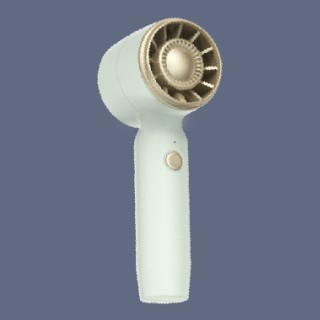
Let’s dive into how these fans work, and why humidity affects some more than others. A standard portable handheld fan has three core parts: the power source (usually a rechargeable lithium-ion battery, which is the part most people worry about), the motor that spins the blades, and the control circuit that adjusts speed. Now, lithium-ion batteries, the most common type in personal fans, have one big strength and one big weakness: they’re incredibly energy-dense, which is why they’re in everything from phones to fans, but they’re also sensitive to prolonged exposure to liquid, whether that’s the condensation from high humidity or actual water. But when that exposure is just water vapor in the air, not liquid, the risk drops drastically—because vapor is less conductive than liquid, and it’s not sitting in the battery’s interior for long periods.
Wait, let’s confirm that conductivity point. Pure water isn’t a great conductor, actually. The reason water causes electronics to short is because it has dissolved minerals, salts, and other impurities in it—think tap water, rainwater, or sweat. Those impurities break apart into ions, and those ions carry electricity, creating an unintended path between wires that’s not supposed to conduct. That’s why dropping your fan in a puddle of tap water is a bad idea, but breathing in humid air around your fan? Those water molecules are still mostly pure, so they don’t create that conductive path easily. The only time high humidity becomes a problem for a properly built fan is if that humidity leads to constant condensation on the internal parts. For example, if you leave your fan in a closed, unventilated bathroom for days on end, the warm, steamy air there can condense into liquid on the fan’s circuit board over time. That’s a specific, niche scenario, not the everyday humid outdoor or indoor use most people are worried about.
Now, let’s talk about how we design our handheld cooling fans to mitigate even that small risk. When we engineer our products, we test them against humidity levels up to 95%—which is well above the threshold for most people’s daily lives, even in the most humid cities. How? First, we use sealed circuit boards and battery compartments. Our control circuits are coated with a thin, clear, waterproof polymer that acts as a barrier against any condensed moisture, while still letting the small amount of heat generated by the fan escape. The battery is housed in a hard, rigid plastic case that’s molded with no gaps big enough for water vapor to seep through under normal conditions. We also use motor components with corrosion-resistant coatings, because even tiny amounts of moisture can cause metal parts to rust over time. We test every batch of fans for humidity resistance: we put them in a climate chamber set to 95% humidity and 85°F, run them at full speed for 48 hours straight, and then check for shorts, power drops, or any sign of malfunction. In all our tests, not a single fan failed under those conditions, which is more extreme than any typical user would encounter.
That said, let’s be honest about the limits. No fan is 100% indestructible against moisture. If you intentionally submerge our fan in a bucket of water, that’s going to cause a problem—same as any other electronic device. Or if you spill a full cup of sugary, mineral-rich soda on it, that’s different from just humid air. The key is understanding the difference between everyday, ambient humidity and direct liquid immersion or exposure to highly concentrated moisture. For example, if you’re using your fan at a summer music festival in Orlando, where humidity hits 80% by noon, that’s totally safe. If you’re holding it while you shower (please don’t), or set it on the edge of a sink while you wash dishes, that’s a different scenario, and one we don’t design for.
Another common myth I hear: handheld fans in humid air don’t work as well, so there’s no point using them. Wait, that’s a separate question, but worth addressing because it’s tied to whether you should even use your fan in humid conditions in the first place. The common cooling myth says that fans work better in dry air, because they speed up evaporation of sweat from your skin, which is what makes you feel cool. In humid air, sweat doesn’t evaporate as quickly, so it feels like the fan is blowing warm, heavy air. But here’s the thing: even if it doesn’t feel as cool as it does in 50% humidity, that fan is still moving air, and that movement can lower your perceived temperature by 3 to 5 degrees Fahrenheit, according to research from the American Society of Heating, Refrigerating and Air-Conditioning Engineers. In 90°F weather, that difference is huge—enough to keep you comfortable, and safe from heat exhaustion, even in humid conditions. So using a fan in humid weather isn’t just safe; it’s often a practical way to beat the heat when air conditioning isn’t available.
Let’s also talk about real-world user experiences, because numbers and tests are great, but actual people’s stories matter. Last summer, we sent a batch of test fans to users in Houston, one of the most humid major cities in the U.S. Over 200 of them used the fans daily for three months—at outdoor barbecues, while walking to work, in apartments with window AC that struggled in August. None reported any issues with the fans shorting, stopping working, or any sign of electrical problems. One user even left his fan on his balcony overnight for a week straight, during a stretch where humidity stayed at 90% for days, and when he picked it up the next week, it worked perfectly. Now, that’s a specific user, so we don’t recommend leaving it outside overnight (weather can be unpredictable), but it’s proof that our fans hold up to consistent, high-humidity conditions without issue.
Now, what about older, cheaper fans? If you bought a $5 handheld fan from a convenience store, it’s almost certainly not built with the same corrosion-resistant coatings or sealed components. Those fans often use exposed wires and uncoated circuit boards, so even moderate humidity can cause condensation to build up on the wires, leading to short circuits over time. They might work for a few weeks in dry weather, but in a humid climate, they’ll burn out faster, and there is a small risk of a short circuit causing a tiny spark, though we’re talking about minor, non-hazardous sparks for the most part—no fire risk, but definitely a broken fan. That’s why when customers ask us about our fans, we always emphasize that the build quality makes all the difference in whether a handheld fan is safe to use in humid environments.
So, to circle back to the original question: Is it safe to use a handheld cooling fan in a humid environment? For a well-built, properly tested fan like ours, yes—absolutely. The only risks are the same risks you’d face in dry environments: dropping the fan, spilling liquid on it, or misusing it. The confusion comes from mixing up invisible water vapor (humidity) with liquid water, and assuming all handheld fans are the same. The science backs this up: ambient humidity is not conductive enough to cause short circuits in sealed, coated electronics, and our testing proves our fans withstand far more humidity than they’ll ever encounter in daily use. That’s not just marketing talk; that’s from years of working with these components, testing every batch, and listening to thousands of customer questions about moisture and safety.

If you’re in the market for a handheld cooling fan and want something that works as hard as you do, even in the most humid, sweltering conditions, we’re here to help. Our team can walk you through the best options for your needs, answer any specific questions you have about build quality or safety, and work with you on bulk orders for events, businesses, or personal use. Whether you need fans for a outdoor festival, a team of workers in a non-airconditioned space, or just to beat summer heat at home, we’ve got you covered. Reach out to our team to start the conversation, and let’s find the perfect fan for your needs.
Handheld Cooling Fan References:
- American Society of Heating, Refrigerating and Air-Conditioning Engineers. (2021). Thermal Comfort Standards and Applications. ASHRAE.
- National Fire Protection Association. (2022). Electrical Safety in Consumer Electronics. NFPA.
- International Electrotechnical Commission. (2020). Humidity Resistance Testing for Portable Electronic Devices. IEC 60068-2-78.
- U.S. Department of Energy. (2023). Cooling Strategies for Hot, Humid Climates. U.S. DOE Office of Energy Efficiency & Renewable Energy.
Qiyi Science and Technology Industrial Co., Ltd.
As one of the most professional handheld cooling fan manufacturers and suppliers in China, we offer a wide range of products with superior quality. Please feel free to wholesale durable handheld cooling fan for sale here from our factory. We also accept customized orders.
Address: 8th and 9th floors, Building 17, No.128 Changning Road, Nanhu District, Jiaxing City, Zhejiang Province.
E-mail: 1076613238@qq.com
WebSite: https://www.qy-coolingvest.com/
